Showing posts with label Africa. Show all posts

Saturday, October 21, 2017

Visit to the Hottest Place on Earth


Locals call it the "Gateway to Hell."


This barren, inhospitable landscape named Dallol is located in the Afar region of northern Ethiopia near the Eritrean border. It's one of the world's most geologically active areas.


Earthquakes, volcanoes, lava lakes, and bubbling sulphur springs are the norm.


It's also the hottest place on Earth. The average annual temperature is almost 95 degrees Fahrenheit (35 degrees Celsius),


and the average daily high temperature soars to 106º F (41º C).


Mother Nature offers little relief. Rainfall is rare, and the "Afar Wind" is characterized as a boiling breeze that leaves one's skin feeling as if it's on fire. Stepping out of an air-conditioned vehicle is truly like stepping into a furnace.


The otherworldly colors are caused by hot, liquid sulphur mixing with iron oxides, copper salts, and other minerals.


The acid lakes are as deadly as they are beautiful.


Dallol is part of the larger 124 by 31-mile Danakil Depression, an area 410 feet below sea level (125 meters). The extreme geological activity is because the depression lies at the junction of three tectonic plates, which are violently tearing apart the land from the rest of Africa. Millions of years from now the Red Sea will once again engulf Danakil and create a new ocean.

After an additional, multi-hour, 4 x 4 journey through


the unforgiving, desert depression,


another natural marvel awaits – the Erta Ale volcano.


The daytime heat is far too intense for the three-plus hours hike to the top of the volcano, meaning visitors depart after dark, arriving at the summit shortly before midnight.

This is what lies inside the continuously active volcano ...


Erta Ale contains just one of five lava lakes on the planet.


In addition to battling the intense heat, visitors must avoid the poisonous sulphuric fumes rising menacingly


from the crater.


Even though there's always the fear the volcano could erupt again at any moment, it's nearly impossible to walk away from the hypnotic spectacle.


After a couple of hours of sleeping on thin mats covering the volcanic rock, it's time to descend before the harsh sun rises again the next day.

It's hard to imagine anyone living in the Danakil Depression, a sight National Geographic once described as the "cruelest place on Earth."

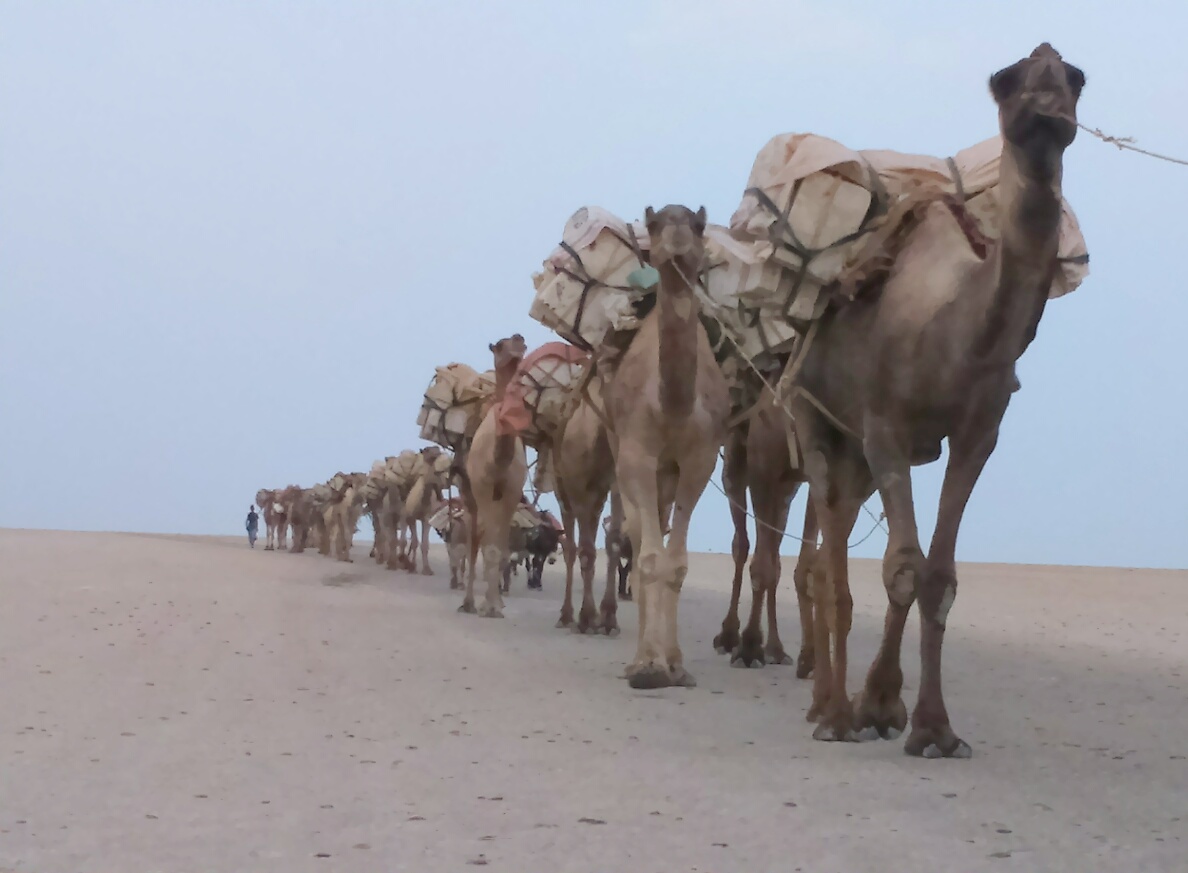
However, the nomadic, Afar people have been crisscrossing this desert for centuries, seeking to eke out a living through the salt trade.


It normally takes the caravans at least a week to arrive


at these salt flats.


Miners first pry the salt free,


then cut it into large slabs,


before shaving it into uniform blocks set for market.


For such backbreaking work, a miner, on a good day, could expect to earn a little over seven dollars, which isn't bad considering some laborers survive on about one dollar a day.


The blocks are then loaded onto the camels for the arduous return trek.


The Danakil Depression would be a highlight for even the most adventurous of travelers, but keep in mind it's a remote, hard-to-reach region; lodging facilities are nonexistent, so sleeping is done under the stars, and toilets entail squatting behind rocks or sand dunes; and there are some dicey security issues.


Courtesy: Ji-Elle – Wikimedia Commons


The border with Eritrea is always politically volatile.


Back in 2012, terrorists kidnapped four tourists and killed five others. Now, solo traveling is outlawed. All groups must be accompanied by armed guards, bearing AK-47s.


Courtesy: Niels Van Iperen – Wikimedia Commons


Still, it's not often one gets to stare into the mouth of an active volcano or visit the hottest place in the world.

NOTE: My article appeared on the travel site The Matador Network.


Friday, July 14, 2017

Zimbabwean Foot Safari


Mana Pools - Zimbabwe - June 2017


It's always a thrill going on a safari anywhere in Africa, but once you've experienced a foot safari, you might never go back to viewing animals from the confines


 of a vehicle.


It's hard describing what it's like walking amongst wild animals, leaving the safety of a car behind – exhilarating, nerve-racking, and, at times, even terrifying.


The risk is well worth it getting the opportunity to interact with animals in their environment and being able to creep to within feet of the planet's most exotic and dangerous creatures.


My sister-in-law took this shot after I slide up on my backside 


right next to


a couple of wild dogs. Don't worry, Mom, wild dogs are normally not aggressive toward humans, although they are ferocious hunters.


My family and I decided to explore Mana Pools with one of Africa's top guides, Stretch Ferreira, a legendary tracker who's known for sometimes pushing things to the limit in his quest to lead his guests ever closer to animals.


Once Stretch drives to the vicinity of the wildlife, it's out of the car. His rules are simple – no talking; always follow in a single-file line behind the rifle-carrying guide;


and even if an animal charges, never, under any circumstances, run.


Running triggers an animal's natural instincts to chase after its prey. Chances are slim that any human is ever going to win a footrace with a wild animal.

On two occasions, animals did charge our group. The first was an aggressive, cantankerous elephant named "The Donald," who decided he didn't want us around, so ran to within a few yards to intimidate us. Then, unexpectedly, he resumed his charge, just stopping a couple of strides away from crushing us.

Here is a YouTube video that was posted by one of fellow safari goers, showing the very end of the charge.


"I'm getting too old for this," said Stretch, still shaking from the experience. "Did anyone get a photograph?" I hadn't had time to breathe, let along pull out my camera.

Accidents can happen.


A guide told me a few years ago a similar charge occurred in Hwange National Park, also in Zimbabwe. One of the frightened guests at the rear of the line decided to run, resulting in the elephant plowing through to get at the fleeing tourist. Two people died.

During our trip, we also had a frightening experience with a lioness, furious that we got too close to her cubs. It wasn't intentional. We walked through some thick brush, unaware that the cubs were present.

Trust me. You never want to hear the roar of an angry, mother lion, especially as it's dashing towards you. Fortunately, we were able to back away in time.

Despite the potential dangers, Stretch has been tracking animals for decades, and – as crazy as it might sound –  we all trusted him with our lives, even while paddling through crocodile and hippo-infested waters.


Stretch is the owner of Goliath Safaris. I can't say enough about his guiding abilities, his camp, and Mana Pools, in general.


-->
I would highly recommend a visit. If not Goliath, at least once in your life, seek out a foot safari. There's no better way to interact with animals on their terms.


Saturday, July 1, 2017

Tracking Apes in Uganda


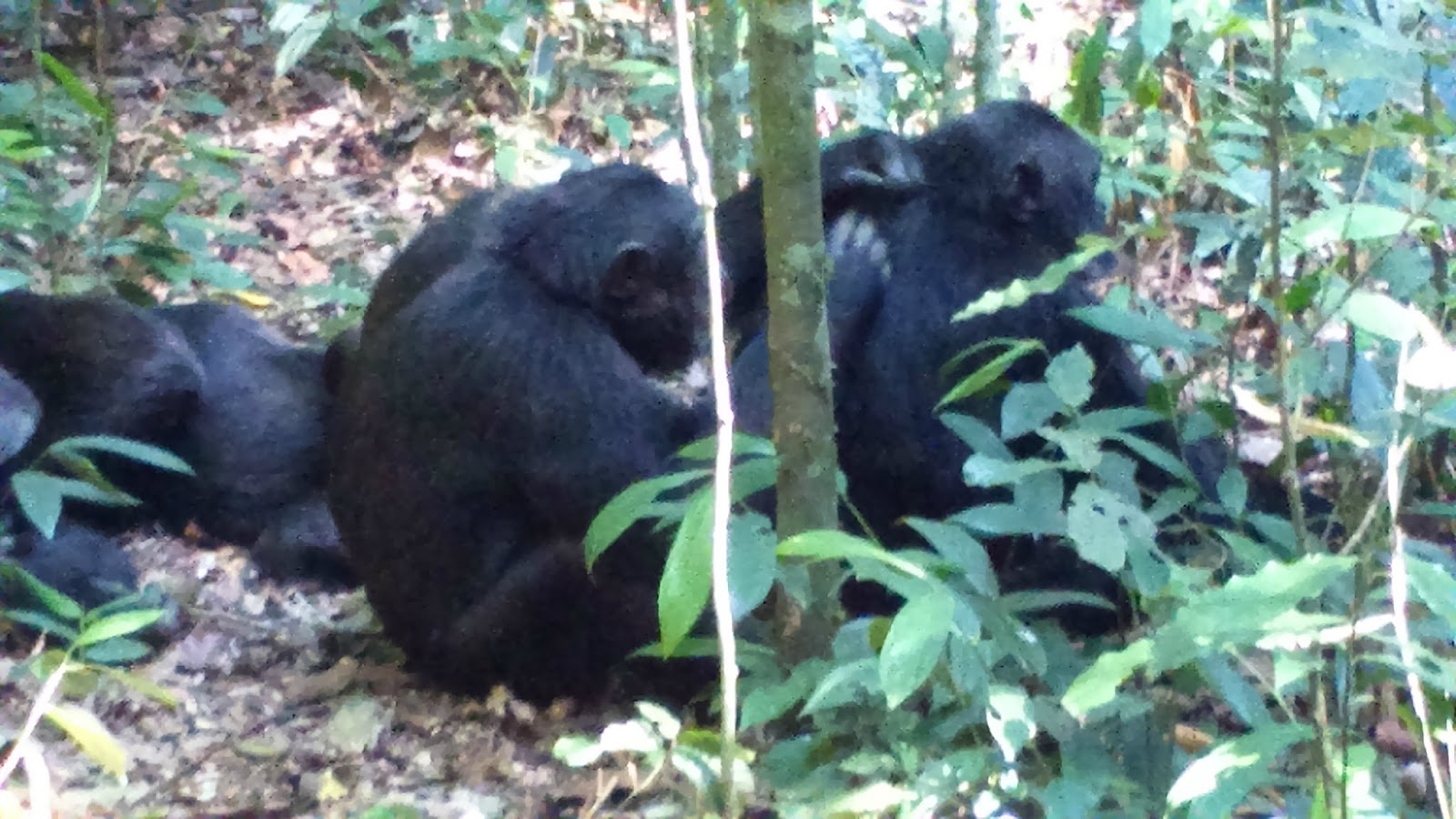
You're looking at humanity's closest relative – the chimpanzee, which shares about 99% of our DNA.

While studying their human-like


features and mannerisms,


it's easy to understand why we have so much in common


with the animals.


These chimps live in Kibale Forest National Park in the mountains of southern Uganda.


This isn't a fenced-in zoo. The chimps roam freely across the 296-square mile park.


It's possible to follow the animals for two or three hours or through an all-day habituation experience. I had the thrill of tracking the primates for 11 hours. 


The park contains about 1,500 chimpanzees, the largest population of the primates in Uganda.


Humanity's second-closest relative is the gorilla, which shares about 98% of our DNA. The endangered mountain gorilla is found in just two spots in Africa. About half of the world's remaining 800 mountain gorillas live in Uganda's Bwindi Impenetrable National Park. The rest are spread out over the Virunga mountains bordering the Democratic Republic of Congo, Uganda, and Rwanda.


I decided to visit Bwindi. The permits aren't cheap. It costs $600 in Uganda, while the Democratic Republic of Congo charges $450, and Rwanda just raised its fees to $1,500.

But I took comfort in knowing that the fees go toward conservation, and if it weren't for tourism, the gorillas would have been wiped out years ago.


The hike isn't easy. It can take a few minutes or even hours to locate the animals. It took us almost two hours; however, it was worth the effort to witness the magnificent primates firsthand.


Because humans can pass diseases to gorillas, visitors are only able to spend one hour with the apes. Also, guests are not allowed to get any closer than seven meters (22 feet) from the animals; however, sometimes, the gorillas take matters into their own hands.

While I was standing on a trail in thick foliage, a young male decided he wanted to walk down the same path I was occupying.

A nearby tracker calmly told me, "Don't move, and whatever you do, don't run." The gorilla slowly crawled up to me and just worked his way around, leaving me untouched.

If you're interested in seeing the gorillas, it's best to book well in advance because daily permits are limited. 

Both Uganda and Rwanda suffered through long years of political and economic strife; however, now  the countries have turned things around for the better, offering wildlife encounters unavailable anywhere else on Earth. 


Friday, January 27, 2017

Day 5 - Summit Attempt on Kilimanjaro


Christmas Day - 2016


My attempt at summiting started on an inauspicious note. While trying to fall asleep for my all-night climb, I suddenly am unable to breathe, the pulse in my neck accelerating faster and faster, like a train racing down a mountain without any brakes.

I experienced the same sensation on Everest and know what to do.

Calm down. Take nice slow breaths. It's just the altitude.

It's not helping. I feel like I'm drowning.

I've come too far to allow my body to stop me. I pop my first Diamox. The storm passes, but the doubts remain.

It's now 11 p.m. Time to begin.

My guide, Raphael, said it's better to hike at night because it gives climbers a chance to see the sunrise at the summit, but more importantly, he said it prevents them from looking up at the imposing challenge of the seemingly, never-ending trail that appears to get steeper by the minute.

"We don't want you to lose hope," he said.

And so – clad in four bottom layers and four top layers, all covered by a heavy, down jacket – I venture across and up the arctic tundra.

Kilimanjaro is a dormant volcano, meaning this section is littered with rocks and scree. At times, it's like trudging through gravel-strewn sand, at others I'm scrambling over boulders.

Virtually nothing lives here. There's little oxygen. There's no protection from the sun. There's minimal surface water.

I peek up and am immediately disheartened by what lies ahead.

"Keep looking at my feet," Raphael snaps. This is a change. Before, my guide has always been so supportive. I resent the tone. "I told you before. Kilimanjaro is steep, then steeper, and then steepest," he says.

O.K., no looking up, but I can't help but notice the numerous exposures seemingly dropping into nothingness in the midnight darkness. I can't ignore the head lamps of the climbers behind me or the tiny, tiny lights from the camp hundreds, if not thousands, of feet below.

For the first time, I'm scared. I know I don't belong here. I feel like an imposter, a fake who managed to finagle his way into the climb.

"I'm intimated by the exposures," I tell Raphael. I'm lying. I'm terrified, terrified that I'll be blown off Kilimanjaro by the gale-force winds.

And now the guilt sets in. Normally, I would be home for Christmas with my family in America. Instead, I insisted on hiking up Kilimanjaro. I think about the phone call that will have to be made to my parents.

"I'm sorry to tell you that your son fell to his death on Christmas."

I'm a lousy son.  How could I have been so selfish. I made a terrible decision.

It's especially traumatic because everyone else seems to be climbing with no problems.

Of course, many others are struggling on the mountain. On another route a few miles away, my friends Brittany and Josh, a 20-something-year-old couple from Florida, are about half-way to the top. Brittany slumps to the ground, breaking down in tears. She can no longer feel her fingers or toes and wants to turn back. Her guide rubs her fingers vigorously, pleading with her to continue. Brittany pushes on, makes it to the summit, then must be assisted back down. At the summit, a thermometer on the outside of Josh's backpack registers 8-degrees Fahrenheit.

We arrive at Hans Meyer Cave, which is really more of an indentation. I'm now at 16,896 feet in elevation (5,150 meters). Normally, once an hour, I take a 5-10 minute break. Instead, Raphael tells me, "Two minutes, and don't sit down."

My anger is building at his insensitivity. Doesn't he realize I'm exhausted after sleeping less than an hour. Doesn't he know I'm freezing. 

"I need more time," I say. "Let's go," he replies.

I consider reducing his tip.

We move forward.

After struggling over a series of boulders, we arrive at the next major milestone – Gillman's Point, situated at 18,638 feet (5,681 meters). This is the highest I've ever been on Earth. The elevation is 1,000 feet above Everest Base Camp, my previous best.

It's at this point that I run into a Swedish exchange student who I've been chatting with at our huts along the way.

Her guide lifts here over a boulder and places her in front of a sign marking Gillman's.

"Hooray, I made it to the top," she says giddily. She's way too happy under the circumstances, especially since we're still an hour and a half from the summit. She appears to be intoxicated. We all look at one another, knowing her trip is over. Her guide fears she's suffering from cerebral edema, swelling of the brain caused by altitude. It's deadly, and she must ascend immediately.

Later, I found out that the exchange student had just succumbed to serious altitude sickness and not cerebral edema. She was fine once she got to a lower altitude. 

And then I feel it coming on. It's similar to the tickling I get in the back of my throat before a cold hits. There's no stopping it. It's going to happen, no matter what I do.

My nemesis has returned. It begins with a sharp pain at the base of my skull and quickly envelopes my brain, turning into a full-blown, altitude-induced headache.

Step 1.

As if on cue, the nausea builds, leaving me with the sensation of having to vomit with each step.

Step 2.

My legs feel like rubber, and I'm staggering up and all over the trail.

Step 3.

Altitude sickness occurs when a person can't get enough oxygen. At higher altitudes, there's less atmospheric pressure, so oxygen molecules are more spread out.  That means there's less oxygen available to breathe, when a climber needs it most. At Kilimanjaro's summit, the body takes in 51% less oxygen.

The only bright side is that the boulders are behind me. All that lies ahead is a gradual incline to the summit.

Even though Raphael says it's normal, I worry that I have serious altitude sickness and, for the first time, consider turning back.

I expect a positive pep talk.

"Do you think I have serious altitude sickness?" I ask. "Only you know your body," he replies.

I'm furious.

Then, Raphael calls my bluff.

"Do you want to go back?" he asks.

Of course, I don't. I can't go back, but the option is officially out there.

"It's your choice," he says, but then quickly adds, "Maybe, you'll need to dig deeper."

Are you serious? Did he just say that? 

Instead, I dig into my pack for another Diamox, which has no effect.

However, now I've got the motivation to continue, my hatred toward Raphael. He disappeared on me during my summit attempt, but I'll show him by succeeding without his help.

Onward I push. I look like a staggering drunk, and I'm fighting back the vomit, but I know I'll make it.

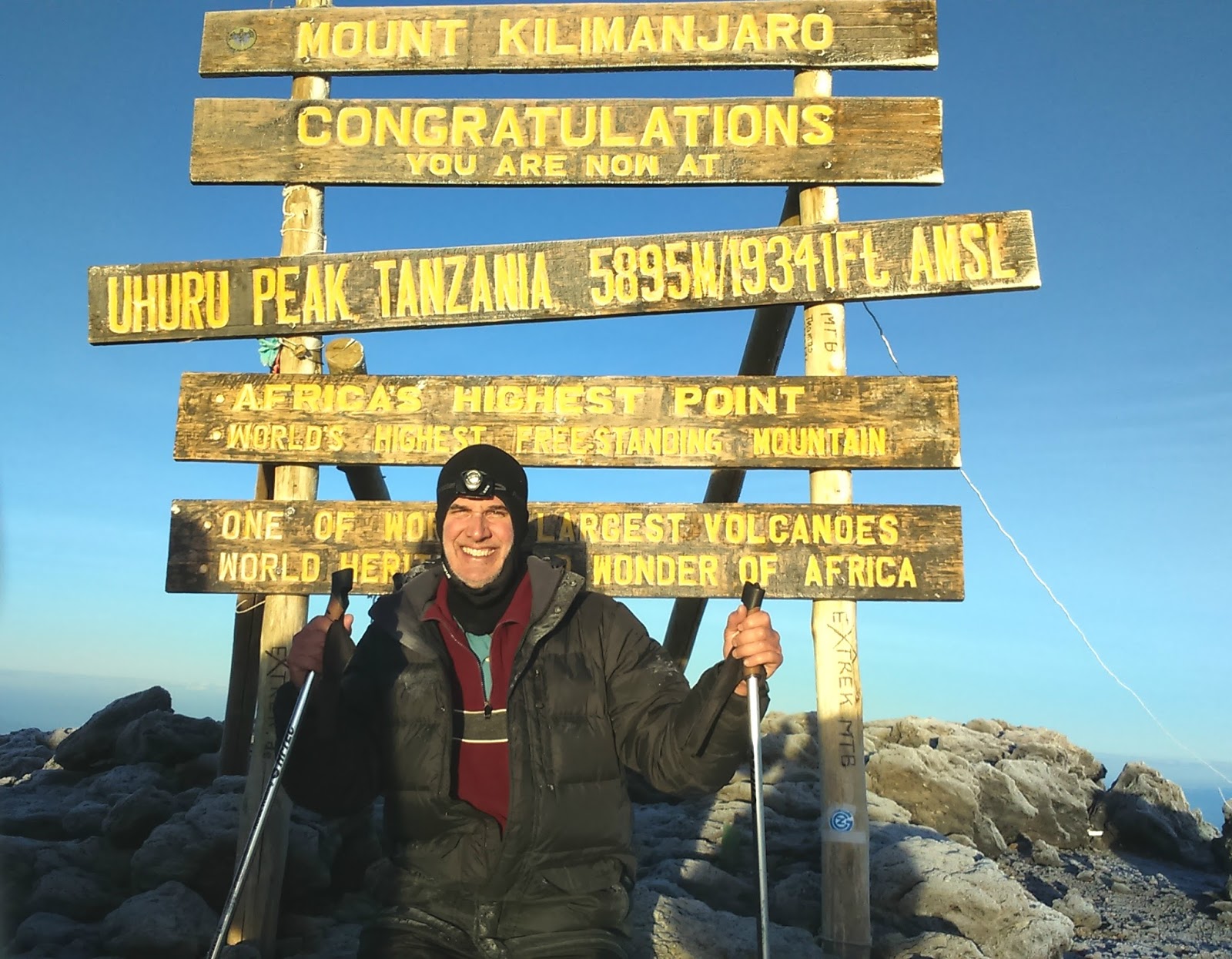
And then I finally arrive at Uhuru Peak – seven hours and 34 minutes after I began.


At 19,341 feet (5,895 meters), it's the highest point on the continent of Africa. I don't feel elation. I don't feel pride at my accomplishment. I just feel relief that I've made it here safely. Really, I'm just wiped out.

And I'm not alone.


There's not much energy to go around at nearly 20,000 feet.


Still, the view is breathtaking.


Unfortunately, scientists worry that these glaciers will one day disappear because of global warming.


Anything above 18,000 feet is considered to be extreme altitude. The longer one stays at the summit the more the body deteriorates. There's time for a few pictures, but then it's necessary to leave, both to get to a lower altitude and to get away from the icy temperatures.

Also, there's still work to be done. The majority of deaths on Mount Everest are while climbers are descending because they're exhausted and tend to make a lot more mistakes. I'm still not down, and Raphael isn't letting up.

"Let's go," he yells.

It took me a little over three hours to descend from the summit and another two hours to hike back to Horombo hut.

The next day, I faced another 12-mile hike (19.7 kilometres) to the main gate, but that was downhill, and I was energized, knowing I already reached my goal of summiting.

Just how dangerous is the climb and what did I learn from the experience? I'll discuss that next in my final entry of Christmas on Kilimanjaro.

----------

DAILY TRIP DETAILS

Start:     Kibo Hut                                      -   15,518 feet in elevation (4,730 meters)
Finish:  Uhuru Peak                                  -   19,341 feet in elevation (5,895meters)
Distance Covered  =  3.4 miles (5.4 kilometres)
Elevation Gain       =  3,823 feet (1,165 meters)
Time of Hike          =  7 hours, 36 minutes

Start:       Uhuru Peak                                   - 19,341 feet in elevation (5,895 meters)
Finish:     Horombo Hut                                - 12,155 feet in elevation (3,705 meters)
Distance Covered    = 9.36 miles (15 kilometers)
Elevation Drop        = 7,186 feet 
Time of Hike           = 5 hours, 27 minutes

Results of nightly health screening:   Pulse = 85   Oxygen level in the blood = 92% out of 100 (Note: An oxygen saturation reading of 95% or better is considered to be normal. If my level drops below 50%, it's serious, and I'll be asked to discontinue my trip.)  

 ----------

Note: These are the exact words I wrote while climbing Mt. Kilimanjaro. After returning from my six-day trip, I transferred my unedited thoughts directly to the blog. In some cases, I added extra information for clarity. You'll find those passages in italics.  

Saturday, January 21, 2017

Day 4 - Christmas on Kilimanjaro


Mt. Kilimanjaro - Christmas Eve, 2016


The hike has become more of a mental challenge, rather than a physical one.

I'm writing from Kibo Hut, base camp for the summit attempt. It's nestled at 15,518 feet. Tonight, I must conquer this foreboding monster to reach my goal.


Base of Mt. Kilimanjaro - Christmas Eve, 2016


During today's six-mile trek, I traversed an


alpine desert.


As I took each agonizing, uphill step, powerful winds slammed


against my body.


During my Everest hike, I made the mistake of looking too far into the distance, worrying how I'd scale each peak, sometimes losing hope I'd ever arrive. Now, my single focus is on the footsteps of my guide, Raphael.


Where he steps, I step. Where he goes, I go. There are no destinations to reach, just follow the leader mile after mile, hour after hour.

Time flows backward and forward. One minute I'm in Nepal, envisioning scaling the Himalayas. The next, I'm fantasizing about summiting Kilimanjaro. The next, I'm reliving Christmases from years past. I miss my family.

Pole, pole

Raphael spots it first – a climber being whisked down the mountain on a one-wheeled stretcher.

"It's your friend," he says.

Without looking, I know who it is, Robert. One of the porters tips up the stretcher, so we can talk.

Robert reminds me of someone who has just awakened from anesthesia – groggy, incoherent, disconnected from reality. He's a victim of the altitude. He'll be fine, as soon as he gets lower on the mountain.  He wishes me luck and is off.

As disappointed as I am by Robert's misfortune, I immediately block it out of my mind. With self-doubt, comes worry. With worry, comes despair. I won't join the 54% who never make it to the top. I'm different. I'm special.

On a brighter note, my medical school friend, Kevin, reached the summit. While I congratulated him on his efforts, he asked my guide to check his oxygen level. Again, 95-100% is normal. His level had plummeted to 62, a reminder that Kilimanjaro always takes a toll on the body.

It's 3 p.m. In about seven hours, I'll wake up in the middle of the night and begin my quest.

I'm praying that I don't succumb to the altitude. I'm still not taking Diamox. "The best medicine of the mountain is water," says Raphael. "It's a lot better than Diamox."

I'm trusting him, but at the first signs of altitude sickness, I'll be popping the pills. I've felt altitude sickness and will do anything I can to avoid being sidetracked from my goal.

Before dinner, Raphael let me know what's potentially in store for this evening, as far as acute altitude sickness.

"Fatigue is normal. Extreme cold is normal. Headaches are normal," he said. I asked for honesty, and he's delivering. "Nausea is normal. Vomiting is normal. Dizziness is normal," he added.

So much for confidence. All I asked is that he tell me immediately if I enter into the realm of severe altitude sickness. Acute altitude sickness is bad enough. Severe altitude sickness – either in the form of pulmonary edema (fluid in the lungs) or cerebral edema (swelling of the brain) – is deadly.

At 5 p.m., I'll eat dinner, try to sleep, and then push toward the summit.

Hopefully, I'll have positive news to report. If not, I promise I tried my best.

----------

DAILY TRIP DETAILS

Start:      Horombo Hut  - 12,155 feet in elevation (3,705 meters)
Finish:    Kibo Hut          - 15,518 feet in elevation (4,730 meters)
Distance Covered  =  5.96 miles (9.6 kilometres)
Elevation Gain       =  3,363 feet (1,025 meters)
Time of Hike          =  4 hours, 46 minutes
Results of nightly health screening:   Pulse = 82   Oxygen level in the blood = 87% out of 100 (Note: An oxygen saturation reading of 95% or better is considered to be normal. If my level drops below 50%, it's serious, and I'll be asked to discontinue my trip.)  

 ----------

Note: These are the exact words I wrote while climbing Mt. Kilimanjaro. After returning from my six-day trip, I transferred my unedited thoughts directly to the blog. In some cases, I added extra information for clarity. You'll find those passages in italics.  


Sunday, January 15, 2017

Day 3 - Christmas on Kilimanjaro


The summit of Kilimanjaro is clearly in view, a snow-capped mountain in the distance beckoning me on, but today I stayed at Horombo Hut for another night. Rather than moving on to a new destination, I did an acclimation hike, climbing to Zebra Rock.


The two-and-a-half hour trek took me to just over 13,000 feet.


The idea is adhering to the old mountaineering adage of "climb high and sleep low". I experienced the benefits of adjusting to a higher altitude before returning to a lower one to recuperate. I'm told this extra day will increase the likelihood that I summit.

The problem with my route up the mountain is the gain in altitude is so rapid that I've got little time to acclimatize, which raises the chances that I'll get altitude sickness. When I hiked to Everest Base Camp, it took nine days to reach 17,600 feet. With Kilimanjaro, I'm heading to 19, 341 feet in just over four days. It seems a bit crazy, but I continue moving forward, choosing to not dwell on the numbers.

Last night, I had my first brush with what I think was a bit of altitude sickness when my head starting hurting, although it could have been the fatigue of hiking five hours in the hot sun.  I swallowed a couple of ibuprofen, and the headache disappeared.

Before beginning my hike, I debated about whether or not to take Diamox, a medicine that supposedly prevents and reduces the symptoms of altitude sickness. Some climbers take it in advance. Others wait until symptoms arise.

Both my doctor and pharmacist recommended I use it prophylactically, but every guide and porter I talked with said wait because of the adverse side effects. I assume they'd know, so I've got it in my pack, just in case.

Overall, my 51-year-old body is holding up under the stress of the ever-increasing altitude, as well as the daily hiking grind.  Each night, my guide, Raphael, checks the level of oxygen in my blood, along with my pulse. He says he's pleased with the numbers.

While I'm grateful my health is being monitored, I'm always nervous when Raphael clips the pulse oximetry onto my finger. An oxygen saturation level in the blood of 95-100% is considered to be normal. If my reading drops below 50%, Raphael says it's serious, and I'll be asked to discontinue my trip. So far, I've not dipped under 80.


Although I'm climbing alone, I've got plenty of company on the trail. For the last two days, I've been hanging out with Kevin, a first-year medical student at the University of South Carolina, and Robert, the owner of a Chicago-based construction company. Robert is the one standing in the middle.

Both are taking the five-day trip, meaning their odds of success of reaching the summit – according to the park service – stand at 27%.

While I enjoyed my acclimatization day, Kevin and Robert headed to base camp. Kevin is young and enthusiastic. He'll make it to the top; however, I'm worried about Robert. Admittedly, he didn't train for the climb, and the 52-year-old tells me he's already anxious to finish. Plus, he's got a screw inserted in his ankle from a previous injury.

Robert decided to do the hike on a whim. Afterward, the practicing Buddhist will head to India for a conference with the Dalai Lama. Kilimanjaro isn't a major priority. Still, I'm hoping for the best for my new mountain friend.

Tomorrow is Christmas Eve. I'll celebrate by hiking almost six miles to the base of the summit. That evening I'll be awakened in the middle of the night for the final push to the top.

So far, so good.

----------

DAILY TRIP DETAILS

Start:     Horombo Hut                                      -   12,155 feet in elevation (3,705 meters)
Finish:  Scenic Overview above Zebra Rock   -   13,123 feet in elevation (4,000 meters)
Distance Covered  =  4.97 miles (8 kilometres)
Elevation Gain       =  968 feet (295 meters)
Time of Hike          =  2 hours, 35 minutes
Results of nightly health screening:   Pulse = 83   Oxygen level in the blood = 90% out of 100 (Note: An oxygen saturation reading of 95% or better is considered to be normal. If my level drops below 50%, it's serious, and I'll be asked to discontinue my trip.)  

 ----------

Note: These are the exact words I wrote while climbing Mt. Kilimanjaro. After returning from my six-day trip, I transferred my unedited thoughts directly to the blog. In some cases, I added extra information for clarity. You'll find those passages in italics.